

Meet the 2026 Pitch Elk Grove Finalists
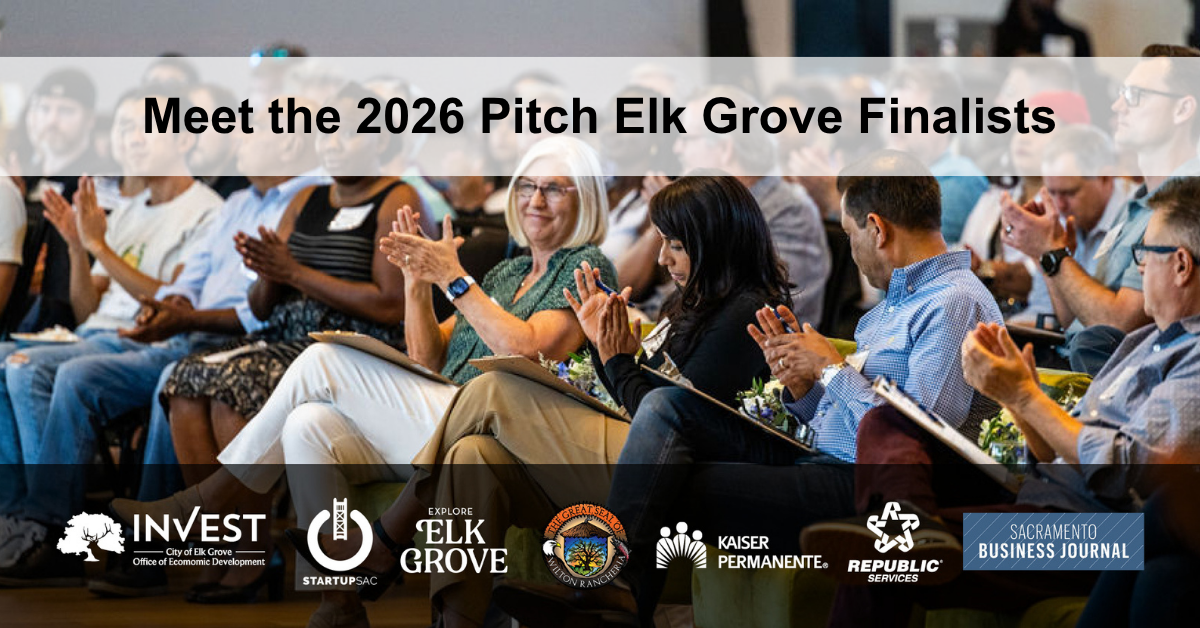
Ten startups will take the stage.
One will have a chance to walk away with a significant share of $20,000 in prize funding.
More importantly, all ten will get something most early-stage founders need: visibility, investor feedback, new connections, and a chance to validate their ideas in front of a live audience.
That is the real value of a pitch competition.
A pitch competition is not simply a contest to see who has the best presentation. It is an opportunity for founders to explain the problem they are solving, demonstrate why their solution matters, and show that they can build a viable business around it.
On Thursday, September 3, the fifth annual Pitch Elk Grove competition will bring ten regional startups to The Center at District56.
The companies come from healthcare, agriculture, construction, artificial intelligence, consumer products, and senior care. Different industries. Different technologies. But they all have one thing in common: they are trying to solve a real problem.
Meet the 10 Finalists
1. BillDecoder — Lodi
Medical bills are confusing. Unfortunately, billing errors are also common.
BillDecoder uses artificial intelligence to help patients identify potential mistakes in their medical bills and create dispute letters.
This is a good example of AI being used for something practical—not just generating another picture of a cat wearing a spacesuit.
2. Core Envision Inc. — Folsom
Construction companies lose time and money when framing layouts are inefficient or inaccurate.
Core Envision is developing AI-powered framing-layout technology designed to improve construction efficiency.
Construction may not always get the same attention as consumer technology, but even small efficiency improvements can have a major impact on project costs.
3. First Bite — Davis
Some of the best startup ideas come from people working directly with a problem.
First Bite has created a medical device that securely holds breathing tubes for neonatal and pediatric intensive-care patients.
It addresses a very specific healthcare challenge—and specific problems often create the strongest startup opportunities.
4. GuLP AAC — Sacramento
Communication is something many of us take for granted.
GuLP AAC is building a communication platform for children who do not speak.
The technology is designed to give children and their families another way to connect, communicate, and participate.
5. Insta Brow — Elk Grove
Not every startup needs to build complex software.
Insta Brow is developing a patent-pending beauty product that simplifies eyebrow application and is designed to last for several days.
Sometimes innovation is simply finding a faster and easier way to complete a familiar task.
6. Krokos Bio — Davis
Saffron is one of the world’s most valuable botanicals, but producing it through traditional agriculture can be expensive and difficult.
Krokos Bio is using plant-cell culture technology to produce high-value botanicals such as saffron.
This is where biology, agriculture, and scalable manufacturing begin to overlap.
7. Lilypay — Lincoln
Funeral expenses often arrive at one of the most difficult moments a family will experience.
Lilypay is creating a financing platform to help families manage those costs.
It is a financial technology solution, but the underlying problem is deeply human.
8. Pheronym Inc. — Woodland
Agricultural pests can reduce crop yields and push growers toward chemical treatments.
Pheronym is developing a more sustainable approach that uses pheromones to help control pests living in the soil.
It is agricultural technology focused on improving both productivity and sustainability.
9. Purple Door Finders — Sacramento
Finding senior housing or care for a family member can be overwhelming.
Purple Door Finders helps families compare senior-living communities and care options.
The product addresses a growing market while helping families make an important—and often emotional—decision.
10. Yeast Bay Bio — Davis
Traditional household insecticides can contain chemicals that consumers may prefer to avoid.
Yeast Bay Bio is developing yeast-based alternatives to conventional insecticides.
The company is another example of biotechnology moving out of the laboratory and into everyday products.
Five Years of Building Founder Momentum
Pitch Elk Grove is celebrating its fifth year.
To mark the anniversary, the event will include a new “Where Are They Now?” video series featuring startups that competed in previous years.
The videos will highlight what happened after those founders left the stage, including:
Product launches
Customer growth
New funding
Strategic partnerships
Acquisitions
Other major milestones
I like this addition because startup success rarely happens during a five-minute pitch.
The pitch may open a door. What founders do during the following months and years determines whether they build a sustainable company.
Learn by Watching the Judges
The finalists will pitch to a panel of investors and startup leaders:
Michelle Hallsten, Sacramento Angels and Greenberg Traurig
George Parrish, Stockton Entrepreneur Lab and Bay Angels
Lokesh Sikaria, Moneta Ventures
Rick Spencer, Growth Factory Ventures
One additional judge to be announced
Founders in the audience should pay attention to the questions the judges ask.
Investors will often reveal more through their questions than through their formal feedback. They may focus on market size, customer acquisition, competition, margins, intellectual property, or the experience of the founding team.
My suggestion is simple: bring a notebook.
You may learn something that improves your own pitch.
Event Details
Date: Thursday, September 3, 2026
Time: 4:30 p.m. to 8:00 p.m.
Location: The Center at District56, 8230 Civic Center Drive, Suite 100, Elk Grove
Cost: Free
Register: 3Common
Pitch Elk Grove is more than an opportunity to watch ten companies compete for funding.
It is a chance to meet founders, connect with investors, understand what is being built in the Sacramento region, and support entrepreneurs who are doing the difficult work of turning ideas into companies.
The takeaway: strong startup ecosystems are not built by founders alone.
They are built when entrepreneurs
